
Originally published: 9 March 2026
Last reviewed for compliance: 9 March 2026
When Is Hi-Vis Clothing Required at Work? (UK Guide)
Hi-vis clothing is required at work where a workplace risk assessment identifies that workers must be clearly visible to reduce the risk of injury from moving vehicles, plant, machinery, poor lighting, adverse weather or other visibility hazards.
In the UK, this most commonly applies across construction, logistics, warehousing, highways, rail, utilities and public-facing maintenance environments.
This guide explains:
- When hi-vis clothing is required at work in the UK
- How risk assessments determine the need for hi-vis PPE
- Which environments commonly require high-visibility clothing
- When EN ISO 20471 applies
- How to choose the right garment type and class
This article is written for Health & Safety managers, compliance teams, procurement professionals, site managers and employers responsible for PPE selection.
👉 Shop compliant options including hi vis vests, hi vis jackets, hi vis trousers and hi vis coveralls, or browse the full hi vis workwear range.
When is hi-vis clothing required at work?
Hi-vis clothing is required when a workplace risk assessment identifies that workers need to be seen clearly in order to reduce risk. This usually means there is a danger from moving vehicles, mobile plant, machinery, low-light conditions, poor weather or complex visual backgrounds.
Hi-vis should be selected as a risk control measure, not simply because it is standard site clothing. For general site visibility, hi vis vests are commonly used, while hi vis jackets are more suitable for outdoor work and adverse weather conditions.
Where hi-vis clothing is being used as PPE, it should normally be suitable for the environment and, where required, compliant with EN ISO 20471.
👉 Read our full guide: EN ISO 20471 Explained: Hi-Vis Classes, Requirements & Employer Responsibilities (UK)
What determines whether hi-vis is required?
The requirement for hi-vis clothing should come from a workplace risk assessment. Employers should consider whether workers need to be visible from a distance and from multiple angles in order to avoid incidents.
Typical factors include:
- Exposure to moving vehicles or plant
- Traffic speed and stopping distance
- Poor natural or artificial lighting
- Bad weather such as rain, fog or low winter light
- Background clutter that makes workers harder to spot
- Whether the task is near loading bays, roads, yards or vehicle routes
- Whether workers need to be visible during night operations
In many of these environments, garments such as hi vis vests with zips and pockets are used where workers need secure fastening and storage for tools, passes or radios, while outdoor teams may need protective outerwear such as hi vis softshell jackets for day-to-day site use.
Which workplaces commonly require hi-vis clothing?
Hi-vis is commonly required in workplaces where visibility is a key part of site safety. The exact garment type and class will depend on the level of risk.
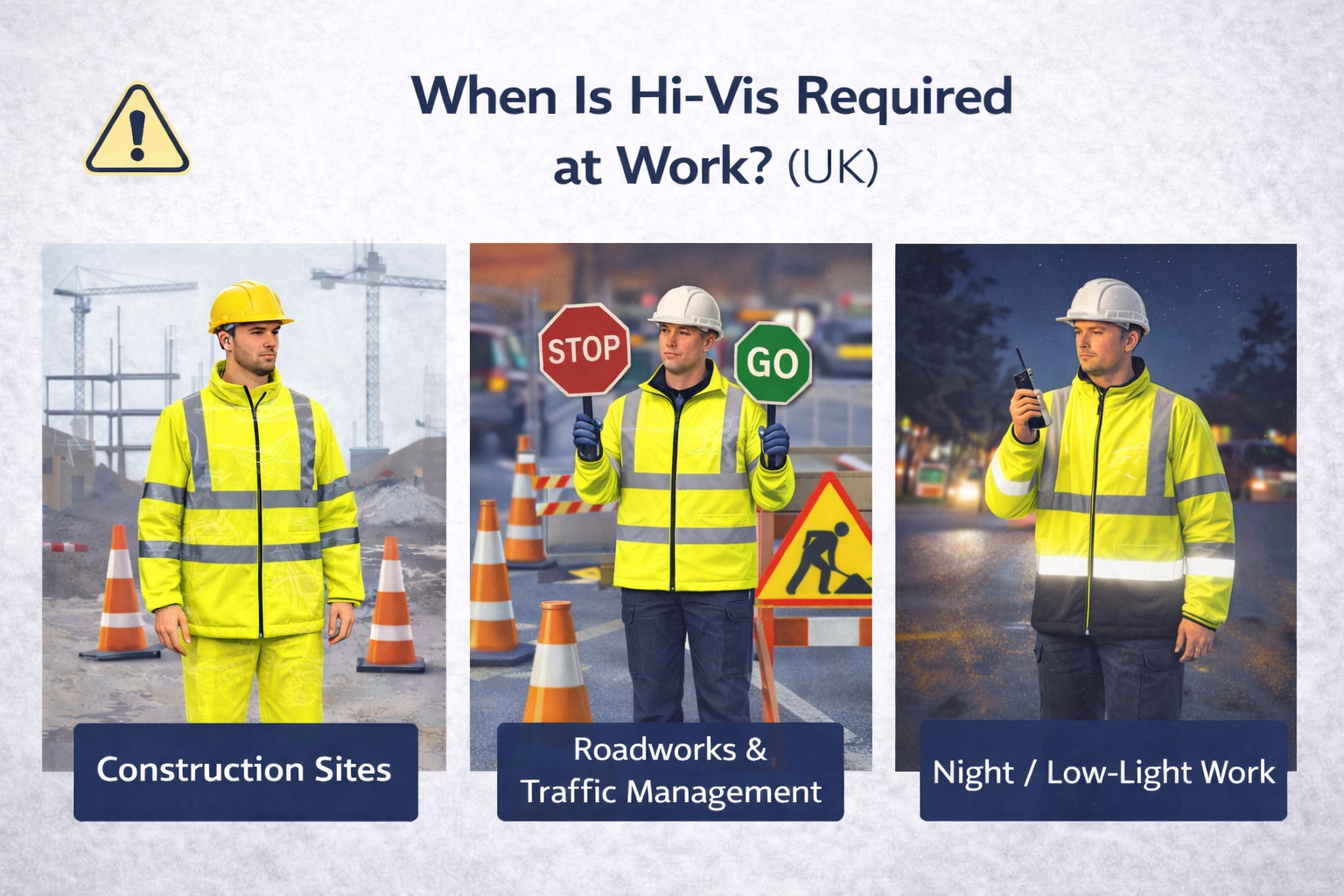
- Construction sites – often require hi vis vests, hi vis jackets and sometimes hi vis trousers for mixed pedestrian and vehicle environments
- Warehousing and logistics – typically use hi vis vests with pockets for practicality and identification
- Roadworks and highways – often require traffic management hi vis clothing and hi vis traffic jackets for higher-risk roadside visibility
- Rail infrastructure – often requires rail specification hi vis clothing and dedicated rail spec hi vis vests for sector-specific compliance
- Utilities and public services – commonly use jackets and outerwear suitable for changing weather conditions
- Facilities and external maintenance – often require general-purpose hi vis garments for mixed-use environments
Is hi-vis always legally required in the UK?
No. UK law does not say that every worker must always wear hi-vis clothing. Instead, employers are required to assess risks and provide suitable PPE where needed.
If visibility is necessary to control risk, then hi-vis becomes part of that PPE requirement.
Where hi-vis is identified as necessary PPE, employers must provide suitable garments free of charge, ensure they are maintained, and replace them when they are no longer fit for purpose.
When does EN ISO 20471 apply?
EN ISO 20471 is the main standard for high-visibility clothing used in hazardous work environments. If hi-vis is required as PPE, garments should usually meet this standard.
EN ISO 20471 covers:
- Fluorescent background materials
- Retroreflective tape
- Garment design and visible surface area
- Class designation based on visibility level
👉 Read more: EN ISO 20471 Explained
How do you know which hi-vis class is required?
Once a risk assessment shows that hi-vis is needed, the next step is choosing the correct class. Higher-risk environments usually require higher visibility coverage.
The class depends on:
- The speed and type of vehicle hazard
- How far away workers need to be seen
- Lighting and weather conditions
- The complexity of the working environment
- Whether the role involves roadside, trackside or night operations
👉 Read our full guide: Hi-Vis Classes Explained: Class 1, Class 2 & Class 3 (UK)
Choosing the right hi-vis clothing for different environments
Different environments call for different garment types depending on the level of risk, weather exposure and whether full-body visibility is needed.
- Hi vis vests – for general site visibility and visitor use
- Hi vis vests with zips and pockets – for site teams needing secure fastening and storage
- Hi vis jackets – for outdoor and weather-exposed work
- Hi vis softshell jackets – for mobile workers needing lighter outerwear
- Hi vis trousers – for full-body visibility systems and higher-risk work
- Hi vis coveralls – for all-in-one visibility and protection
- Rail spec hi vis clothing – for trackside environments
- Traffic management hi vis clothing – for roadside and highways work
Examples of when hi-vis is usually required
- Working around forklifts in a warehouse or depot
- Operating on a construction site with active plant
- Carrying out roadside repairs or traffic management duties
- Working outdoors in poor light or bad weather
- Undertaking rail or infrastructure maintenance
- Moving through loading bays or reversing areas
In these cases, the right solution may range from simple hi vis waistcoats to specialist roadside hi vis clothing or rail specification garments, depending on the environment.
Common mistakes
Even where hi-vis is supplied, mistakes can still lead to poor compliance or poor protection.
- Using non-certified garments – bright clothing is not automatically compliant PPE
- Choosing the wrong class – a lower-risk garment may be unsuitable for higher-risk work
- Ignoring garment condition – faded or damaged garments may no longer be effective
- Branding over critical visibility areas – logos should not reduce reflective or fluorescent coverage
👉 Related guide: Workwear Logo Placement Guide
👉 Garment lifespan guide: How Long Does Hi-Vis Clothing Stay Compliant? (UK Guide)
What about branded hi-vis clothing?
Branded hi-vis clothing can still be compliant, but logo placement must be handled carefully. Printing or embroidery should not interfere with reflective bands or reduce visible fluorescent areas below required thresholds.
This is particularly important on garments such as hi vis vests, jackets and specialist outerwear used in rail or roadside environments.
Choosing the right hi-vis clothing
To choose the right hi-vis clothing for work:
- Start with a formal risk assessment
- Confirm whether hi-vis is required
- Determine the right class for the environment
- Choose garments suited to the task and conditions
- Check any site, rail or traffic-management-specific rules
- Ensure garments are maintained and replaced when needed
👉 Browse the full range: Hi Vis Vests | Hi Vis Jackets | Hi Vis Trousers | Hi Vis Coveralls | Rail Spec Hi Vis | Traffic Management Hi Vis
FAQ: When is hi-vis required at work?
Is hi-vis clothing a legal requirement in the UK?
Hi-vis clothing is required where a workplace risk assessment identifies visibility as a necessary control measure. Employers must then provide suitable PPE free of charge.
Does every construction site require hi-vis?
Many construction sites do require hi-vis because of moving plant, deliveries and mixed pedestrian and vehicle routes, but the exact requirement depends on the site rules and risk assessment.
Does hi-vis clothing need to meet EN ISO 20471?
Where hi-vis is used as PPE to control workplace risk, garments should usually meet EN ISO 20471.
How do I know which hi-vis class I need?
The correct class depends on the risk assessment, traffic speed, lighting conditions and working environment. Higher-risk sites often require higher-visibility garments.
Can branded hi-vis still be compliant?
Yes. Branded hi-vis can remain compliant provided logos do not interfere with reflective tape or reduce fluorescent material below the required level.