
Workwear Logo Placement Guide: Where Can Logos Be Added to Branded Workwear?
Originally published: 04 March 2026
Last reviewed: 04 March 2026
When ordering branded uniforms, one of the most common questions businesses ask is:
“Where can our logo be placed on workwear?”
Logo placement affects brand visibility, garment appearance and — in the case of hi-vis clothing — whether the garment remains compliant with workplace safety standards.
This guide explains the most common logo positions used on workwear, how print and embroidery affect placement, and what businesses should consider when branding hi-vis clothing and everyday workwear uniforms.
👉 Start here: Custom Workwear With Logo | Branding & Printing
How logo placement affects branded workwear
The best logo position depends on the garment type, the size and shape of your artwork, the branding method being used, and whether the garment needs to remain compliant for site or hi-vis use.
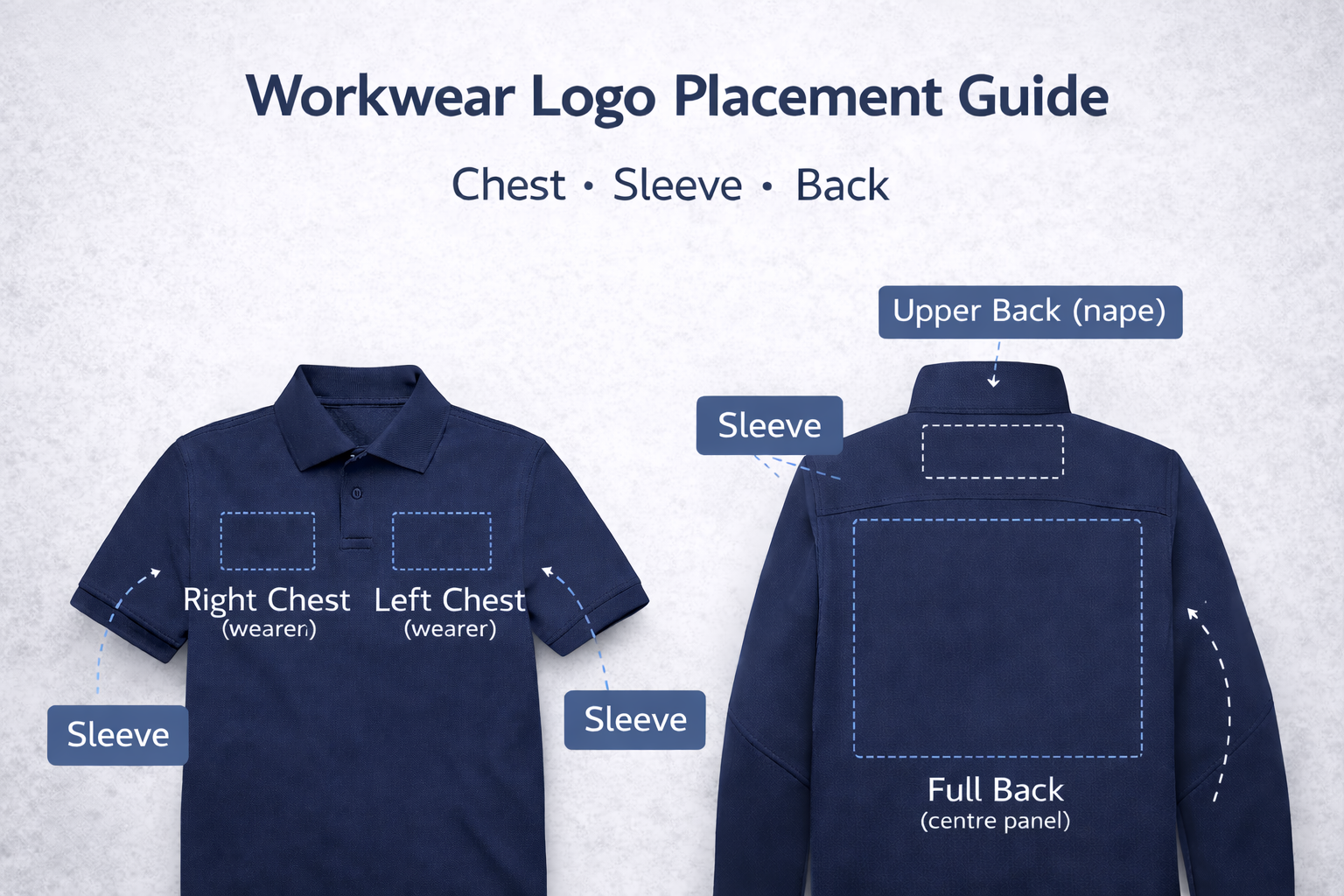
For example, smaller chest logos are often best on workwear polo shirts, fleeces and everyday uniforms, while larger back prints are commonly used on hi-vis jackets, hi-vis vests and outerwear.
Common logo placement positions on workwear
Most branded uniforms use one or more of the following logo positions.
Left chest logo
The left chest is the most common logo placement on workwear. It is widely used across construction, industrial, trade and corporate uniforms.
This position works well for both printing and embroidery, and is commonly used on:
A chest logo provides professional brand visibility without overpowering the garment, which is why it is often the default choice for embroidered uniforms.
Right chest logo
Some businesses choose to place their logo on the right chest, particularly when the left chest area is used for:
- Name badges
- Employee ID panels
- Secondary branding
This placement is commonly used in hospitality, corporate environments and facilities management teams, and is often suitable on officewear, polos and lighter uniform garments.
Large back logo
Back logos are typically larger and designed for maximum visibility. They are commonly used on:
- Hi-vis jackets
- Hi-vis vests
- Workwear hoodies
- Outerwear
Printing is usually the preferred method for large back logos because it allows larger artwork and more detailed designs.
👉 View Printed Workwear
Sleeve logos
Sleeve logos are often used as a secondary branding position. This placement is commonly used for:
- Company websites
- Partner logos
- Department identifiers
Sleeve branding is popular on jackets, hoodies and polo shirts where additional brand visibility is useful.
Leg logos on workwear trousers
Some companies place logos on workwear trousers or cargo pockets. This is particularly common in:
- Construction companies
- Groundworks teams
- Rail contractors
Because trousers experience heavy wear, embroidery is often preferred for durability. This can be relevant on workwear trousers and some hi-vis trouser styles where suitable.
Best logo placements by garment type
- Workwear polo shirts – usually best with left chest embroidery
- Workwear fleeces – often suit embroidered chest logos
- Softshell jackets – chest logos work well, with sleeve branding as a secondary option
- Hi-vis vests – often suit chest branding plus larger back print where compliance allows
- Hi-vis jackets – commonly use chest, sleeve and back branding depending on layout
- Workwear jackets and bodywarmers – can suit either print or embroidery depending on fabric and logo size
- Officewear and corporate garments – usually best with smaller embroidered chest logos
Print vs embroidery: how branding method affects logo placement
The best logo placement often depends on the branding method used.
Printed workwear
Printing is ideal for:
- Large back logos
- Full-colour artwork
- Hi-vis garments
- Waterproof jackets
Modern garment printing techniques allow sharp detail, gradients and complex artwork reproduction.
👉 Explore Printed Workwear
Embroidered workwear
Embroidery is typically best suited to:
- Chest logos
- Polo shirts
- Fleeces
- Corporate clothing
Because embroidery stitches the logo directly into the fabric, it creates a durable, professional finish that withstands repeated washing.
👉 Browse Embroidered Workwear
Not sure which method to choose? Read our guide: Print vs Embroidery: Which Branding Method Is Right?
Logo placement on hi-vis workwear
When branding hi-vis garments, logo placement must not compromise EN ISO 20471 safety compliance.
Hi-vis clothing must retain:
- Minimum fluorescent background material
- Required reflective tape coverage
- Correct garment visibility classification
Logos must not:
- Cover reflective tape
- Reduce fluorescent material
- Alter the certified garment class
Large logos or incorrect positioning can affect compliance if not checked properly. This is especially important on hi-vis vests, hi-vis jackets, traffic management hi-vis and rail specification hi-vis workwear.
👉 Read: EN ISO 20471 Explained
👉 Shop: Hi-Vis Workwear
Use the online designer to compare logo positions
On selected garments, you can choose branding positions and application types online before ordering. This helps customers compare front and back branding options, decide whether print or embroidery is more suitable, and build a clearer idea of the finished garment before checkout.
This is particularly useful when comparing branded custom workwear, printed workwear and embroidered workwear before ordering.
👉 Start building your order: Design Custom Workwear
Typical logo sizes for workwear
Although logo size depends on garment type and artwork design, typical sizes include:
- Chest logos: 80–120mm wide
- Sleeve logos: 70–100mm wide
- Back logos: 200–300mm wide
These sizes help ensure branding remains visible while maintaining garment balance and compliance.
Digital proof and approval before production
Before production begins, a digital artwork proof is sent for approval to confirm:
- Logo positioning
- Correct sizing
- Colour accuracy
- Compliance-safe placement
Production begins only once your proof has been approved.
👉 Learn more: Branding & Printing
Not sure where your logo should go?
Our team can advise on the best logo placement based on:
- Your logo design
- The garment type
- Branding method
- Compliance requirements
- The working environment
📩 Contact us for branding advice
Start building branded workwear for your team
Explore our ranges:
FAQ: Workwear logo placement
Where is the best place to put a logo on workwear?
The most common placement is the left chest, offering clear visibility and a professional appearance.
Can logos be added to hi-vis clothing?
Yes — provided they do not cover reflective tape or reduce fluorescent material required for EN ISO 20471 compliance.
Is printing or embroidery better?
Printing is best for larger logos and hi-vis garments, while embroidery is ideal for durable chest logos on polos, fleeces and everyday uniforms.
Can I choose logo position online before ordering?
On selected garments, you can choose branding positions and application types online before ordering, helping you compare front and back options before checkout.