
Originally published: 9 March 2026
Last reviewed for compliance: 9 March 2026
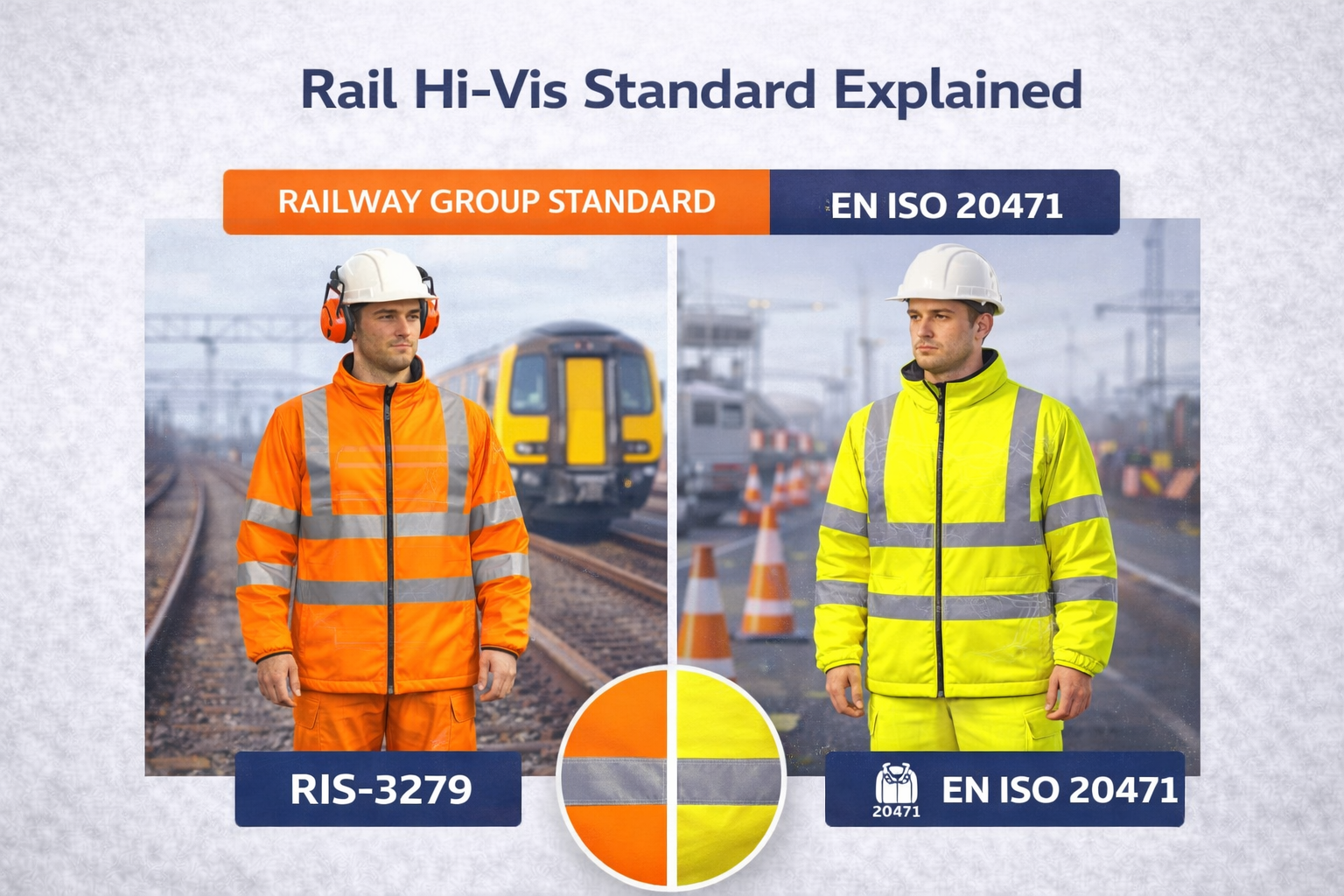
Rail Hi-Vis Standard Explained: RIS-3279 vs EN ISO 20471
Rail workers in the UK often require specialist high-visibility clothing that meets additional standards beyond standard EN ISO 20471. One of the most important of these is RIS-3279-TOM, the rail industry specification for high-visibility orange garments used on railway infrastructure.
This guide explains:
- What RIS-3279 means
- How RIS-3279 differs from EN ISO 20471
- Why rail hi-vis clothing is usually orange
- Which garments are commonly used for rail work
- How employers select compliant rail workwear
This article is written for rail contractors, infrastructure workers, procurement teams and safety managers responsible for selecting compliant rail workwear.
👉 Browse compliant options including rail specification hi vis workwear, rail spec hi vis vests, rail hi vis jackets and bodywarmers and rail spec coveralls, or view the full hi vis workwear range.
What is RIS-3279?
RIS-3279-TOM is the UK rail industry specification that defines requirements for high-visibility clothing used by workers operating on railway infrastructure.
The specification helps ensure workers remain clearly visible in rail environments, particularly around moving trains, trackside equipment and complex backgrounds.
RIS-3279 works alongside the main high-visibility clothing standard:
👉 EN ISO 20471 Explained: Hi-Vis Classes, Requirements & Employer Responsibilities (UK)
In simple terms:
- EN ISO 20471 defines the core visibility requirements
- RIS-3279 adds rail-specific garment requirements
- Rail garments must still meet the correct hi-vis class
In practice, this means employers often need dedicated rail specification hi vis clothing rather than relying on general-purpose high-visibility garments.
Why is rail hi-vis clothing orange?
In the UK rail industry, high-visibility garments are typically orange rather than yellow. This creates a consistent and recognisable safety standard across railway infrastructure projects.
Orange garments provide strong contrast against many of the backgrounds commonly found in rail environments, including vegetation, ballast and trackside structures.
Because of this, many rail organisations and contractors require orange hi-vis garments for trackside work. This often includes orange rail spec hi vis vests, orange outerwear and rail-specific all-weather clothing.
👉 Related guide: Orange vs Yellow Hi-Vis: Which Should You Choose?
RIS-3279 vs EN ISO 20471
RIS-3279 does not replace EN ISO 20471. Instead, it works alongside it.
Garments used for rail work normally need to meet both standards.
- EN ISO 20471 defines the minimum visibility performance requirements
- RIS-3279 helps ensure garments are suitable for rail environments
- Rail garments are typically orange high-visibility clothing
- The garment must still meet the correct hi-vis class designation
This is why rail buyers often choose dedicated categories such as rail hi vis polos and t-shirts, rail hi vis jackets and bodywarmers and rail spec coveralls rather than general hi-vis garments.
👉 Learn more about garment classes: Hi-Vis Classes Explained: Class 1, Class 2 & Class 3 (UK)
Which hi-vis class is used for rail work?
Rail work typically requires higher levels of visibility because workers may be operating near moving trains, heavy equipment and complex infrastructure environments.
The correct class should always be determined through a formal risk assessment, but rail environments commonly require:
- Class 2 garments for certain operational roles
- Class 3 garments where full-body visibility is required
Higher-visibility garments help ensure workers can be seen from greater distances and from multiple angles. Depending on the task, this may mean using rail spec hi vis vests for simpler visibility requirements, or more protective combinations including rail jackets and bodywarmers and rail spec coveralls.
👉 Related guide: When Is Hi-Vis Clothing Required at Work? (UK)
Which garments are used for rail work?
Rail workers require garments designed for demanding infrastructure environments and changing outdoor conditions.
Common examples include:
- Rail spec hi vis vests
- Rail hi vis polos and t-shirts
- Rail hi vis jackets and bodywarmers
- Rail spec coveralls
- Rail specification hi vis workwear for the wider range
👉 Browse the full range: Rail Specification Hi-Vis Workwear
Choosing the right rail hi-vis clothing
The correct garment choice depends on whether workers are carrying out trackside tasks, infrastructure maintenance, outdoor inspections or all-weather operational work.
- Rail spec hi vis vests – for essential visibility in rail environments where lighter garments are suitable
- Rail hi vis polos and t-shirts – for warmer conditions and layered sitewear systems
- Rail hi vis jackets and bodywarmers – for outdoor work, poor weather and colder shifts
- Rail spec coveralls – for all-in-one visibility and weather protection where required
- Rail specification hi vis workwear – for the full rail-focused range
RISQS verified rail workwear supplier
HiVizWorkwear.net is a RISQS verified supplier. RISQS (Railway Industry Supplier Qualification Scheme) is the qualification system used across the UK rail industry supply chain.
RISQS verification confirms that suppliers meet the operational, compliance and safety requirements expected by rail organisations and infrastructure contractors.
For rail procurement teams and contractors, this provides additional assurance that garments supplied are suitable for use within the rail sector.
👉 Browse Rail Specification Hi-Vis Workwear
Common mistakes with rail hi-vis clothing
Even experienced contractors can run into compliance issues if the correct garments are not selected.
- Using standard hi-vis instead of rail-spec garments
- Choosing yellow garments where orange is required
- Ignoring the correct hi-vis class
- Using worn or damaged garments
- Incorrect logo placement on garments
Branding should never interfere with reflective tape or reduce the required fluorescent material coverage.
👉 Related guide: Workwear Logo Placement Guide
👉 Garment lifespan guide: How Long Does Hi-Vis Clothing Stay Compliant? (UK Guide)
Can rail hi-vis clothing be branded?
Yes, rail hi-vis clothing can still be branded with company logos provided branding does not interfere with reflective materials or reduce the fluorescent background area below compliance thresholds.
Choosing the correct branding method is also important, especially on garments such as rail jackets and bodywarmers, rail hi vis vests and other outerwear used repeatedly in demanding environments.
👉 Related guide: Print vs Embroidery: Which Branding Method Is Right for Your Workwear?
👉 Ordering guide: How to Order Branded Workwear for Your Business
How to choose compliant rail hi-vis clothing
To choose the correct rail workwear:
- Start with a formal risk assessment
- Confirm whether rail-specific standards apply
- Check whether RIS-3279 garments are required
- Select the correct hi-vis class
- Choose garments suited to weather and working conditions
- Ensure garments are maintained and replaced when necessary
👉 Browse compliant options: Rail Specification Hi-Vis Workwear | Rail Spec Hi-Vis Vests | Rail Hi-Vis Polos & T-Shirts | Rail Hi-Vis Jackets & Bodywarmers | Rail Spec Coveralls
FAQ: Rail hi-vis standards
What does RIS-3279 mean?
RIS-3279-TOM is the rail industry specification for high-visibility clothing used in UK rail infrastructure environments.
Is RIS-3279 the same as EN ISO 20471?
No. EN ISO 20471 is the main international high-visibility clothing standard, while RIS-3279 is a rail-specific specification used alongside it.
Why do rail workers wear orange hi-vis?
Orange garments provide strong visibility against common rail infrastructure backgrounds and are widely specified for trackside work.
What hi-vis class is required for rail work?
This depends on the workplace risk assessment, but Class 2 or Class 3 garments are commonly used in rail environments.